Seeing The System of Community Engagement

Photo by Danika Perkinson on Unsplash
We Are Better Together For A Reason
I’ve been thinking about how to bridge divides. As one does these days.
A lot of the work I’ve done over the years would not have been successful were it not for partnerships, collaboration, and authentic relationship building. Conversely, things that went wrong or failed often did so because of issues related to communication (too much/too little/too formal/too informal/too directive/too ambiguous/too unkind, etc etc), listening but not hearing, readiness for change, power dynamics, trust. Basically the ‘people’ stuff.
I know I’m not unique in that regard, most things designed for social impact and do-gooding are relational, not transactional. We see what a transactional world looks like. How devoid it can be of the things we yearned for when young, what we might wish for, or what we truly need to feel seen, valued, a part of something bigger than ourselves. What’s the switch from transaction to connection?
Sometimes in the busy-ness of getting things done, working together, trying to make a difference however we may, we miss what makes a good partnership or collaboration work. We miss the nuance of humans repeatedly interacting and working together to solve a problem. Community engagement should be another word for saying “hello, how you doing today? Oh gosh, that sounds rough. How can I help? How can we make it better? What if we try this?” This is the everyday social glue holding it all together that doesn’t make it into a what works clearinghouse, a funder’s report or even in meeting minutes. We can’t always look back years later and say why we all were able to make something good happen together. Sometimes we can’t understand why the divide between good intentions and poor results actually got bridged to the detriment of all parties involved.
Instead, collaboration or engagement is reduced to attendance counts, meeting logs, survey responses that might tell you who showed up. But that doesn’t tell you who holds trust, who bridges silos, or whose absence would quietly collapse the entire thing. I used to think that one of the ways to get things done was to outlast the sticky wicket, the “house of no”, or the naysayer at every meeting. While still a valid strategy on occasion, I think a better way is to really dig deep and understand what makes a collaboration work. What are the secret ingredients for strengthening the you + me + us equation? How and why are we better together? What’s possible when we find the right answers to that question?
This, of course, has been a theme. Whether it’s building community resilience or measuring ecosystems or improving community engagement. Or whether it’s creating the spaces where we are better together, where it’s not about a transaction. It comes down to how people build and sustain relationships with each other in ways that help or heal rather than hinder or harm. It’s that social fabric I keep going on about. Oh, I will outlast the naysayers of hope, trust me!

Photo by Vik Molina on Unsplash
Seeing the system as a relational network is a precondition for strengthening it.
So, let’s talk science and the methods of measuring relationships. As I and many others have written about before, network analysis makes that visible. Rooted in graph theory, it maps relationships between organizations as nodes and edges, then calculates structural metrics — degree, betweenness, closeness — that reveal who connects, who conveys, and who is essential but unrecognized. In other words: There is math behind our relationships and that math gives us a way of understanding how we all work or relate to each other. The result is a strategy tool for seeing and strengthening the system or community you're actually working in.
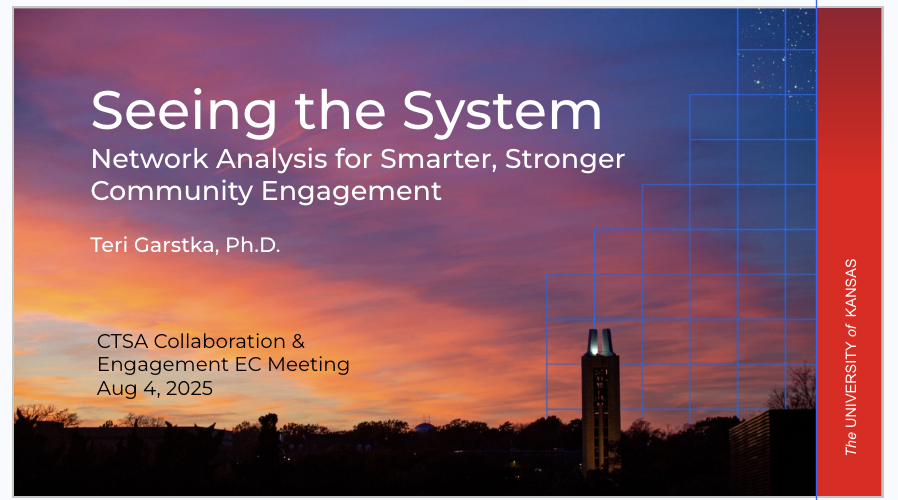
At the invite of my colleague Dr. Lloyd Michener way back in the year 2025, I had an opportunity to speak about community engagement with the Clinical and Translational Science Awards program, a national NIH-funded network of roughly 60 academic medical research institutions. The University of Kansas is a part of this network and their Frontiers CTSI, working collaboratively across our own state and in the Kansas City area. This large group is looking to speed the translation of scientific discoveries into real-world treatments and improved patient care. When we talk about collaborations that can change the world, this is what we are talking about.
And that's exactly where network analysis becomes relevant. A research enterprise that depends on cross-sector collaboration faces the same structural challenges as any complex ecosystem: who connects the silos, who reaches the communities that formal systems miss, and whether the network is actually as integrated as it appears on an org chart. Those questions sit at the intersection of network science and community engagement and the tools we use to understand community resilience apply just as directly to research collaboration and engagement.
I shared the basics behind network analysis and how to use the findings to bridge the divide between researchers, organizations, and community members. Practical points that can help inform the community engagement space in what I hope is a novel way - you can access the PDF here.
Ad astra per aspera
Find a Different Kind of Influencer
So what are the takeaways?
Collaboration has structure and structure can be measured. Collaboration is how we design and implement initiatives across our partnerships and networks, and how change actually happens through shared resources and aligned action. Understanding its structure - is it cohesive? is it one partner holding all the relationships? - helps us improve both the process and the impact.
Counts and surveys show participation. Network analysis shows how the system actually works. To improve engagement, we need to see where trust flows and where it breaks, not just who attended. Measure the relationships that push something towards impact instead of checking-the-box. That gets us all further along than a table in a report.
Every network has two types of hidden influencers. Edge organizations (and the people they represent) operate at the margins of formal systems but are deeply embedded in community life. In public health terms, this is is essential for last-mile delivery of treatment or services and legitimacy. Boundary spanners bridge across sectors, disciplines, and institutional silos, enabling coordination and cross-silo innovation that no single actor can achieve alone. I love a good boundary spanner - find them and cultivate their talents!
Unmapped influencers are structurally invisible. Without structural analysis, edge organizations and boundary spanners may be functionally essential but excluded from decisions, resources, and credit. Shine the light, make them visible, and get them at the table. They often aren’t the organizations or people who toot their own horn. Toot it for them.
Network structure can be measured, tracked, and changed. Metrics like density, modularity, and network diameter describe the system's overall health. Measuring the same network over time reveals gaps, emerging leaders, and whether interventions are actually strengthening relationships — something I’ve explored further in Ecosystems Designed for Change: Moving Beyond Mapping and Building Effective Networks: Insights from Social Care Systems.
Seeing the system is a precondition for strengthening it. Network analysis connects abstract ideas about collaboration to actionable insight — who holds power, who is missing, and where to invest next. Pull the threads to find what or who is connected, how the pieces all fit together, and how that living network of impact is interdependent and powerful.
Once you see it, you can’t unsee it: It looks a lot like possibility and hope.

Photo by Beatrice Bolondi on Unsplash
For a deeper look at how network structure underlies community resilience, see The Building Blocks of Community Resilience and related features.
What I’ve Been Reading
Sheldrake, Merlin. 2020. Entangled Life. London, England: Bodley Head.
Chiang, Ted. Exhalation: Stories. 2019. New York: Alfred A. Knopf.
Mikanowski, Jacob. 2023. Goodbye, Eastern Europe: An Intimate History of a Divided Land. New York: Pantheon.
Zurn, Perry, & Bassett, Dani. S. (2022). Curious Minds: The Power of Connection. MIT Press.